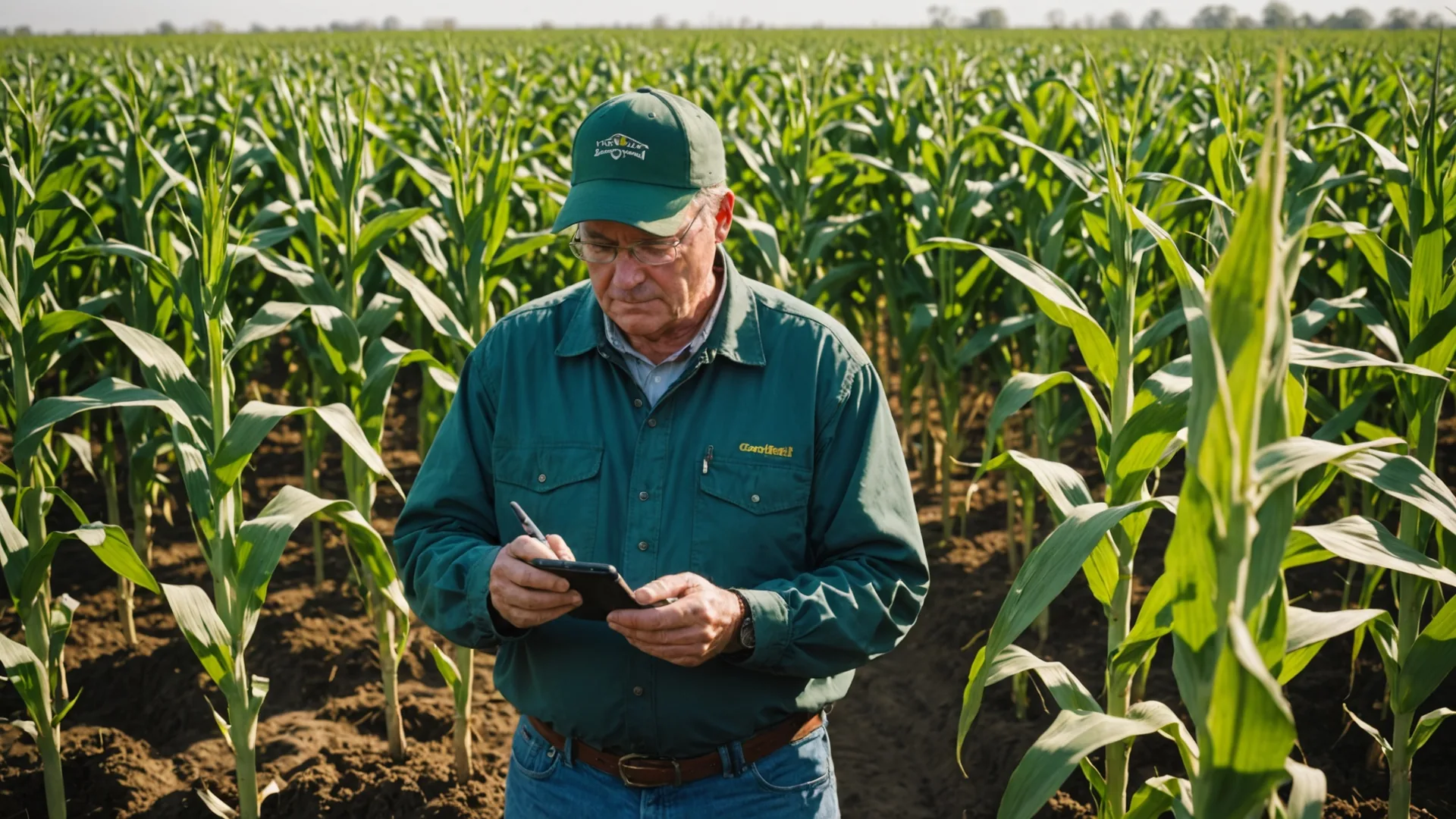

Farm management software has gotten genuinely good at some things over the past decade. The major platforms do real work: field boundaries drawn cleanly, yield maps stored and accessible, planting records logged season over season, equipment telemetry captured and connected. For an operator running 1,500 acres who used to track all of this in spreadsheets and paper notebooks, the improvement is substantial.
We've spent a lot of time working with farmers who use these platforms, and the data they contain is impressive — thousands of field-seasons of yield monitor data, soil sample records going back years, application histories tied to field zones. That's genuinely valuable.
The question that comes up consistently is: what do I do with all of this? And it's here, at the transition from data stored to decision made, where most farm management platforms still leave the operator mostly on their own. That gap is worth understanding clearly before you invest in any additional tools to fill it.
What the Major Platforms Do Well
Climate FieldView, John Deere Operations Center, Granular, and Ag-Analytics have all converged on a strong core feature set. They excel at data aggregation and visualization — pulling yield monitor data from the combine, equipment data from telematics, and displaying it all in a coherent field-level interface. These platforms also handle the machinery integration challenge reasonably well. ISOBUS connectivity and proprietary APIs let data flow from the equipment to the platform without manual entry, which removes a major source of data quality problems.
Soil sample integration has improved considerably. Most platforms now accept uploaded lab results and display them as management zone maps, making it easier to see spatial variation in pH, phosphorus, and potassium levels against historical yield patterns. That side-by-side view — where did I yield well, and what does the soil look like in those zones — is genuinely useful context for planning.
Record-keeping for FSA and RMA compliance has become a strong use case. Acreage reporting, planting dates, and field-level input records are much easier to document and retrieve on these platforms than in older paper-based systems. For operators who deal with crop insurance reporting and FSA acre verification, this alone often justifies the subscription cost.
Collaboration with agronomists and co-op advisors has improved too. Shared field access, notation tools, and the ability to attach photos from scouting visits are all features that platforms have built out over the past few years. Having the farmer and their trusted advisor looking at the same map is better than emailing screenshots.
The Gap: From Data to Decision
Here's where it gets honest. Storing last year's yield map in excellent resolution does not tell you what nitrogen rate to apply to Zone 4 of Field 7 this June. Showing you that your soybeans averaged 52 bu/ac in 2024 does not tell you whether your corn following those soybeans this year needs 190 or 215 lbs N/ac at sidedress time. Logging your planting date as May 3rd does not tell you whether planting on April 26th would have changed your GDD accumulation trajectory enough to matter at VT.
The major platforms are primarily backward-looking. They are exceptional archives. But row-crop farming is a forward-looking activity — every significant input decision you make this season has to be made before you know the outcome. The decision isn't "what did I do in 2023?" It's "what should I do next week, in these specific field zones, given the weather forecast and the crop's current growth stage?"
Most platforms address this with recommendations that come from one of two places: agronomist annotations (a human expert looking at the data and writing a note) or product-company recommendations embedded in the platform (a seed dealer or fertilizer company that has partnered with the platform to deliver suggestions). Neither of these is a systematic, data-driven inference from the farm's own field history and current conditions. They're valuable inputs, but they're not the same thing as an algorithmic recommendation calibrated to your specific field zones.
Why Alerts Alone Don't Close the Gap
Several platforms have built alert and notification systems that flag events: equipment off-route, unusual spray patterns, weather events above a threshold. These are useful for operational awareness. But they're not agronomic decision support in the meaningful sense.
An alert that says "precipitation in the next 48 hours may affect planned applications" is a weather notification with some field-logic wrapper around it. It tells you what the weather might do. It doesn't model how that weather event interacts with your current soil nitrate levels, your crop's V8 uptake rate, and the optimal sidedress window for your specific hybrid on your specific soil series to produce a ranked recommendation: apply field A today, delay field B by 4 days, skip pre-sidedress soil sampling on zone 3 of field C because the window has closed.
That kind of specific, quantified recommendation requires an inference model running against field-zone-level data — not just an event trigger. And to our knowledge, no major farm management platform currently delivers this as a native feature at field-zone resolution. Some are working toward it. But as of today, the decision model lives in the agronomist's head, not in the software.
A Practical Comparison of What You Get
| Capability | What Current Platforms Do Well | What's Still Missing |
|---|---|---|
| Yield data storage | Excellent — year-over-year field maps, zone averaging, visual comparison | No forward inference: "given this yield history, what does next season's potential look like by zone?" |
| Soil health data | Good lab integration, zone mapping, overlaid with yield | No dynamic tracking — soil test from 2022 is still the displayed baseline even if conditions have changed |
| Weather integration | Current conditions, 7-day forecasts, historical precipitation overlays | No agronomic model connecting weather forecast to specific field-zone intervention windows |
| Nutrient recommendations | Basic rate calculators using field-average soil test values | No zone-level dynamic recommendations calibrated to current crop stage, weather outlook, and yield target |
| Scouting prioritization | Manual scouting routes and note-logging tools | No satellite-driven anomaly detection that prioritizes which zones to scout this week |
| Agronomist collaboration | Shared field access, photo annotation, note-sharing | No shared model — agronomist and farmer may be looking at the same map but working from different mental models |
Integration vs. Replacement
It's worth saying clearly: we don't think the right answer is to throw out your existing farm management platform. The data it holds is valuable. The compliance record-keeping it does saves time. The equipment telemetry is real. The task is to get more decision value out of the data you're already collecting — not to rebuild your data infrastructure from scratch.
The question is where in the workflow the decision-intelligence layer sits. What we've found is that the most productive setup is one where the farm management platform handles data collection, storage, and compliance records, and a separate inference layer handles the forward-looking recommendation: which fields need action this week, what that action should be, and what the expected yield impact of acting vs. waiting looks like.
That's why Acreweave is designed to connect to existing platforms rather than replace them. We pull yield data, soil records, and field boundaries from FieldView or Operations Center via API or CSV export, run our zone-level models against that data alongside satellite NDVI and local weather feeds, and deliver action cards that tell the operator what to do this week — with confidence levels and expected yield impacts attached to each recommendation. The data lives where it already lives. The decision support lives where it's been missing.
Questions Worth Asking About Any Farm Software Tool
Whether you're evaluating what you currently have or looking at adding something new, these are the questions that cut to the decision-support gap quickly:
- Does it tell me what to do this week, or does it show me what happened last season?
- Are its recommendations calibrated to my specific field zones, or are they county-level or generic?
- Does it give me a confidence level and an expected yield impact for each recommendation?
- Does it update recommendations as weather forecasts change during the growing season?
- Does it connect to my existing data sources without requiring me to re-enter historical records?
Most farm management platforms today can answer the last question well and the first four poorly. That's not a criticism of what they built — data management is genuinely hard, and they solved it. The forward-looking decision layer is a different and harder problem. It's also the one where the yield impact is largest for the operator.
Knowing what your tools do well and where they leave work for you or your agronomist is the starting point for building the right combination. The data you've been collecting for years is more valuable than most of the platforms currently help you extract.